An AI detector for essays works by measuring how predictable your writing is. It runs your text through a language model, checks how likely each word was, looks at variation in sentence length and style, and compares the patterns with known human and AI writing to estimate a probability.
Most people treat AI detectors like magic boxes. You paste text in, a number comes out, and you either relax or panic. But once you understand what's actually happening inside, those numbers stop being scary and start being useful.
Think of it this way. If you've ever finished a friend's sentence before they did, you already understand the core idea behind every ai detector. Language models are extremely good at guessing the next word. Detectors simply ask: how easy was this text to guess?
The Big Idea Behind Every AI Detector for Essays
Large language models like ChatGPT write by predicting one word at a time. At each step, they tend to pick words that are statistically likely. That's what makes AI text smooth and readable. It's also what makes it detectable.
Humans don't write like that. We pick odd words, start sentences with "And," write one long sentence followed by a short one, and wander off into tangents. Our writing is messier and less predictable.
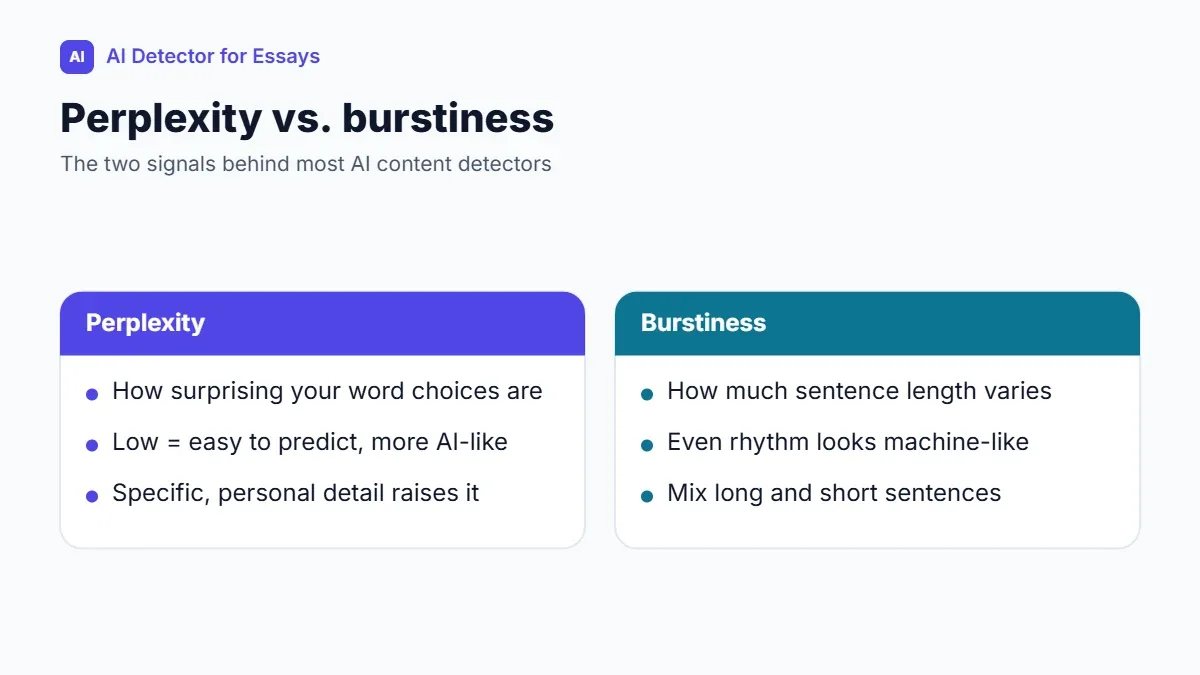
An AI detector for essays turns that difference into numbers. Two measurements do most of the heavy lifting: perplexity and burstiness.
Perplexity: How Surprising Is Your Writing?
Perplexity measures how surprised a language model is by your words. Low perplexity means the model could easily predict the text. High perplexity means your word choices were unexpected.
Here's a simple example. Read these two sentences:
- "Climate change is one of the most pressing issues facing our world today."
- "My grandfather's apple orchard bloomed three weeks early this year, and he blamed the warm February."
The first sentence is extremely predictable. You've read it a hundred times. The second is specific, personal, and full of details a model couldn't guess. The first has low perplexity; the second has high perplexity.
Why low perplexity raises AI scores
AI models naturally produce low-perplexity text because they choose likely words. So when an entire essay reads like the first sentence above, an AI content detector grows suspicious.
Why humans sometimes score low too
Formal academic writing encourages safe, standard phrasing. Students who follow writing templates closely, or who write in a second language with a smaller vocabulary, can produce low-perplexity text without any AI involved. This is one major source of false positives.
Burstiness: The Rhythm of Human Writing
Burstiness describes how much your sentences vary. Human writing tends to come in bursts. A long, winding sentence with three clauses. Then a short one. Then something medium.
AI-generated text often has a steady, even rhythm. Sentences land at similar lengths with similar structures, paragraph after paragraph. It feels polished, but it's also flat.
Detectors measure this variation across your essay. Low burstiness combined with low perplexity is a strong signal that a model may have written the text.
Quick self-check
Read one of your paragraphs out loud. If every sentence takes about the same breath, your rhythm may look machine-like. Mixing short and long sentences helps your writing sound more natural, whether or not a detector ever sees it.
Classifier Models: Learning From Examples
Perplexity and burstiness are useful, but modern detectors go further. Many use a classifier, a machine learning model trained on large collections of human-written and AI-written text.
During training, the classifier learns subtle patterns: favorite phrases, typical paragraph shapes, common transitions, and how arguments are usually structured. When you submit an essay, it compares your text against everything it learned and outputs a probability.
Why training data matters so much
A classifier is only as good as the examples it learned from. If it trained mostly on blog posts, it may misjudge academic essays. If it never saw writing from non-native English speakers, it may treat their style as "unusual" and flag it.
That's exactly what researchers found when they tested popular GPT detectors on TOEFL essays: the tools flagged non-native writers' work as AI far more often. Choosing an AI detector for essays trained with academic writing in mind helps reduce this bias.
From Whole-Essay Scores to Sentence Highlights
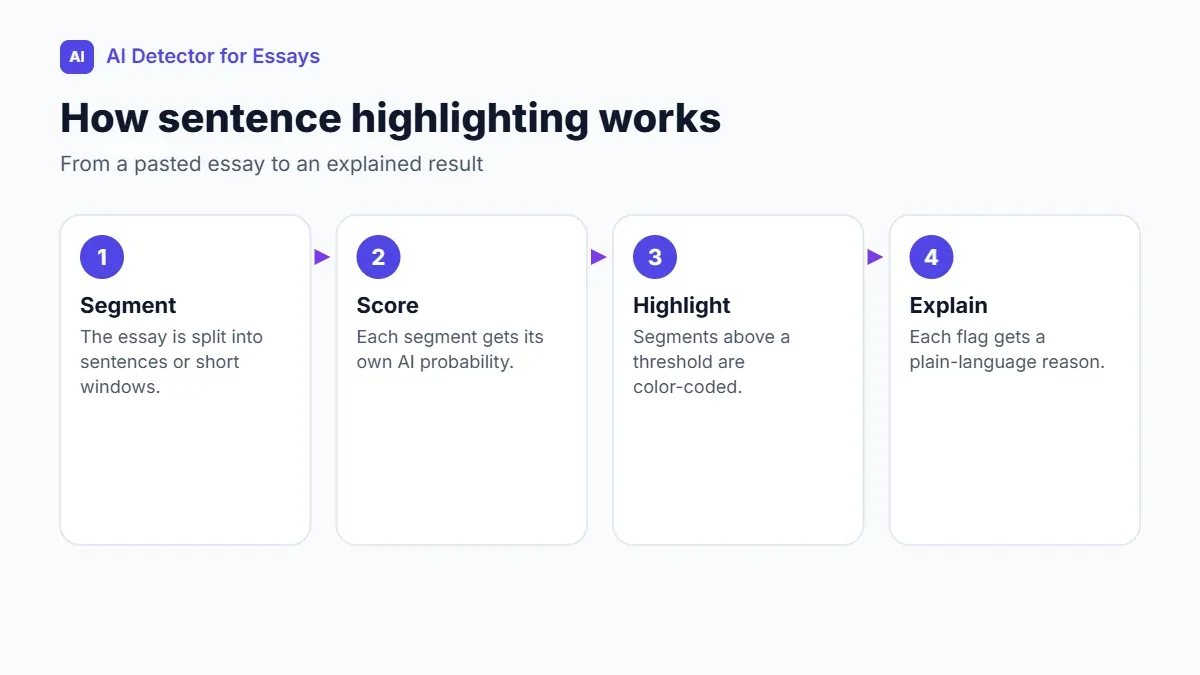
Early detectors only gave a single score for the entire document. Today, the best AI detector tools score text in smaller chunks, often sentence by sentence.
Here's roughly how that works:
- Segmenting: The essay is split into sentences or short windows of text.
- Scoring: Each segment gets its own probability, using the surrounding context.
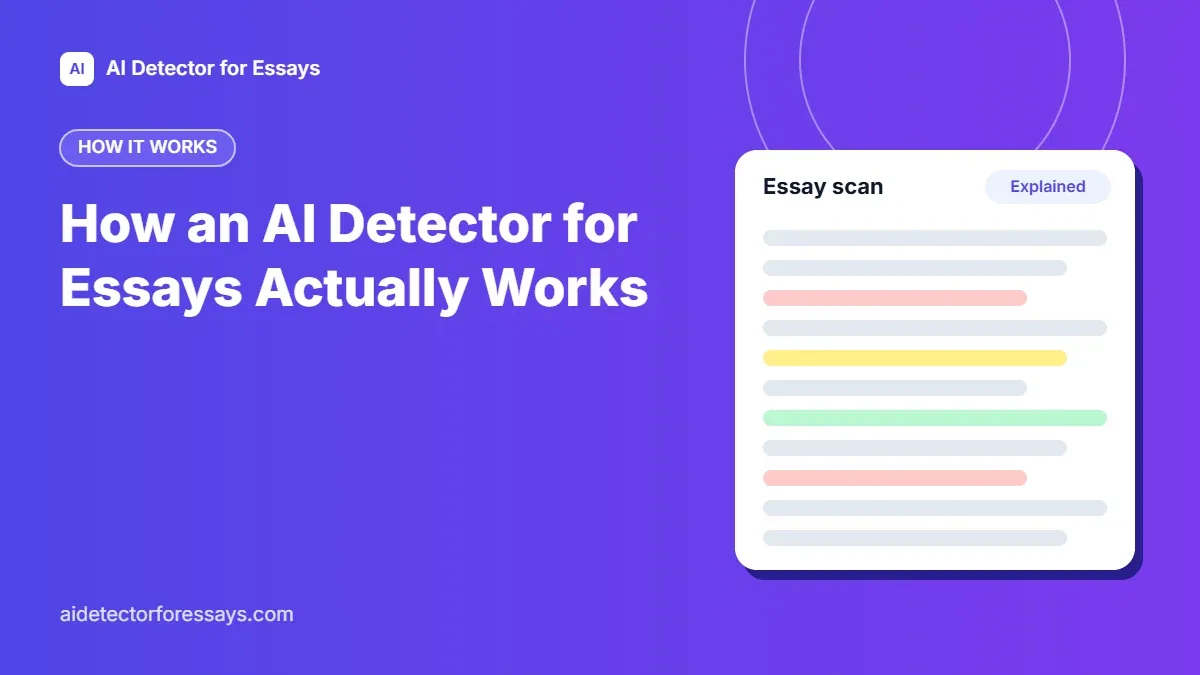
- Highlighting: Segments above a threshold are colored so you can see them instantly.
- Summarizing: The tool combines segment scores into an overall estimate.
Sentence highlights are far more useful than a single number. They show you where the concern is, so you can review those lines, add specifics, or explain your process to a teacher.
A Walkthrough: One Paragraph Through the Detector
Let's make this concrete. Imagine Priya, a first-year college student, pastes this paragraph from her sociology essay into an AI detector for essays:
"Social media has significantly transformed the way people communicate. Furthermore, it has created new opportunities for connection. However, it also presents numerous challenges. Last semester, I watched my younger cousin spend four hours a night on group chats while her grades dropped from A's to C's."
Here's what the detector does, step by step.
It splits the paragraph into sentences
Four sentences become four separate segments, each scored with the surrounding context in mind.
It measures predictability
The first three sentences are extremely common phrasing. A language model could have predicted almost every word. Their perplexity is low. The fourth sentence, about her cousin, is specific and surprising. Its perplexity is much higher.
It checks rhythm
The first three sentences are similar in length and structure, each opening with a familiar pattern. The fourth breaks that rhythm completely.
It highlights and explains
The detector highlights the first three sentences and explains they use generic, highly predictable phrasing with stacked transitions. The fourth sentence stays unhighlighted.
Priya wrote all four sentences herself. But now she knows exactly which lines sound bland. She rewrites the opening with a sharper claim drawn from her cousin's story, and the paragraph becomes both more human and more persuasive. That's detection working as a writing coach rather than a judge.
The lesson from Priya's paragraph
Detectors don't punish formal writing on purpose. They react to predictability. The fix is rarely to "trick" the tool. It's to write with the kind of specific detail and natural rhythm that good teachers have always asked for.
What an AI Score Really Means
This is where most people get confused. An "80% AI" score does not mean 80% of the essay was written by AI. It usually means the detector is about 80% confident that the text shows AI-like patterns.
Those are very different statements. Confusing them leads to unfair accusations and unnecessary panic.
How to read a score sensibly
- Low scores suggest human-like patterns, but don't guarantee a human wrote it.
- Middle scores are uncertain territory. Look closely at the highlighted sentences.
- High scores are a reason to ask questions, not proof of misconduct.
Our accuracy disclaimer walks through what each range means and what to do next.
Why AI Detectors Make Mistakes
Every ai detector makes two kinds of errors. Understanding them protects you whether you're a student or a teacher.
False positives
A false positive happens when human writing gets flagged as AI. Common causes include formulaic essay structures, heavy use of standard academic phrases, very short texts, and writing by non-native English speakers.
False negatives
A false negative happens when AI writing slips through as human. This often occurs when someone heavily edits AI output, mixes it with their own writing, or uses tools designed to rephrase text.
The limits are real. OpenAI itself withdrew its AI classifier after acknowledging its low rate of accuracy. That's why responsible tools frame results as probabilities, not proof.
How Explanations Make Detection Fairer
Knowing that a sentence was flagged is only half helpful. Knowing why it was flagged changes everything.
An AI detector for essays that explains its reasoning might say a sentence was flagged because it uses highly predictable phrasing, matches common AI transitions, or lacks specific detail. That gives you three advantages:
- You can judge the flag yourself instead of blindly trusting a number.
- You can improve weak writing by adding examples and varying sentence structure.
- Teachers can have fair conversations grounded in specific evidence.
This is the approach we take on AI Detector for Essays: every highlight comes with a plain-language "why flagged" explanation.
Detection Plus Proof: The Complete Picture
Even the smartest AI content detector only analyzes the final text. It can't see how you wrote it. That's a big blind spot.
Imagine two students submit identical essays. One typed it over three evenings with dozens of revisions. The other pasted it in one go. A detector sees the same text. A process recorder sees two completely different stories.
That's why pairing detection with a tool like our Writing Verifier makes sense for important assignments. It records typing time, pastes, and revisions, then gives you a shareable replay as evidence of your work.
Practical Tips to Write Naturally Human Essays
You don't need tricks to pass an AI check. You need good writing habits. These tips make your essays stronger and more clearly yours:
- Add specific details: names, dates, places, numbers, and personal observations.
- Vary sentence length: follow a long sentence with a short, punchy one.
- Cut filler transitions: replace "Furthermore" with a sentence that actually connects ideas.
- Use your own examples: classroom discussions, readings, or experiences only you would know.
- Keep your drafts: outlines, notes, and earlier versions are your best proof of process.
Want a second opinion on flow? Run your draft through our free readability checker to spot long, monotonous sentences.
None of these tips are about fooling software. They're the same habits writing teachers have recommended for decades. The difference now is that a good AI detector for essays can point out, sentence by sentence, exactly where your writing slipped into autopilot, so you know where to focus your next revision.
Key Takeaways
Short on time? Here's what to remember:
- Detectors measure predictability, not authorship.
- Perplexity tracks surprising word choices; burstiness tracks sentence variety.
- Classifiers learn from examples, so training data shapes accuracy and bias.
- Sentence highlights with explanations are far more useful than one overall number.
- Scores are confidence levels, not the share of an essay written by AI.
- Pair detection with drafts or a writing replay for the complete picture.
Conclusion
An AI detector for essays measures predictability through perplexity, burstiness, and trained classifiers, then turns those signals into sentence highlights and a probability. It's a powerful tool, but it reads patterns, not minds.
Use detection as a guide, read the explanations, and keep proof of your writing process. Curious how your own essay scores? Run a free check now, no sign-up needed.