The best AI detector for essays does more than print a percentage. It highlights the exact sentences that look machine-written, explains why they were flagged, handles long essays, and admits its limits. If a tool can't show its reasoning, treat its score as a guess, not a verdict.
Here's a scene that plays out in thousands of dorm rooms every semester. A student finishes a 1,800-word history essay at 1 a.m., pastes it into a random AI checker, and sees "87% AI" in big red letters. She wrote every word herself. Now she's panicking, rewriting good sentences into worse ones, and wondering whether her professor uses the same tool.
That panic is exactly why choosing the right AI detector for essays matters. A good one gives you clarity. A bad one gives you anxiety and nothing to act on. In this guide, you'll learn the nine things that separate a trustworthy checker from a coin flip, so you can pick one with confidence.
Why the Right AI Detector for Essays Matters More Than Ever
Teachers now see AI-assisted writing in almost every class. Students, meanwhile, worry about being wrongly accused. Both sides end up relying on the same thing: an AI content detector that claims to know who (or what) wrote a piece of text.
The problem? Not every ai detector is built for essays. Many were designed for marketing blogs or SEO copy. Essays are different. They follow formal structures, use academic vocabulary, and often sound "polished" in ways that generic detectors confuse with AI.
So before you trust any score, you need to know what's happening under the hood and what a reliable tool should give you.
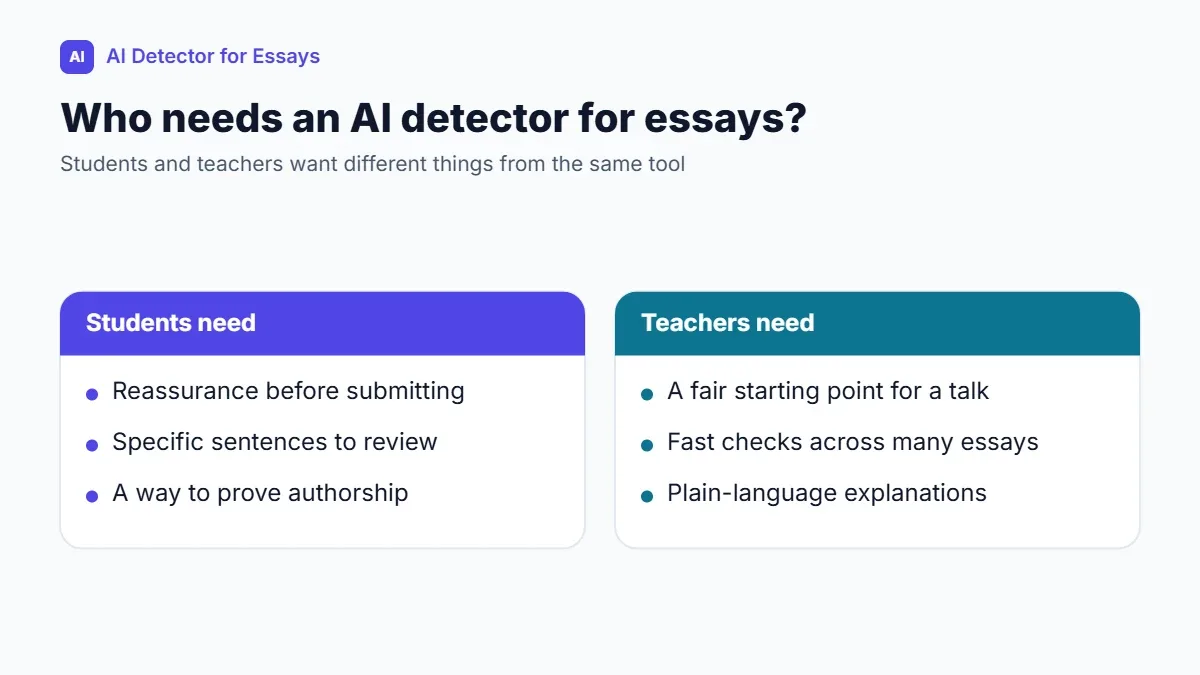
What students actually need
- Reassurance before submitting that their own writing won't be misread.
- Specific sentences to review, not a vague overall score.
- A way to prove authorship if a teacher raises questions later.
What teachers actually need
- A starting point for a conversation, not an automatic accusation.
- Fast checks across many essays without copying and pasting all evening.
- Plain-language explanations they can share with students and parents.
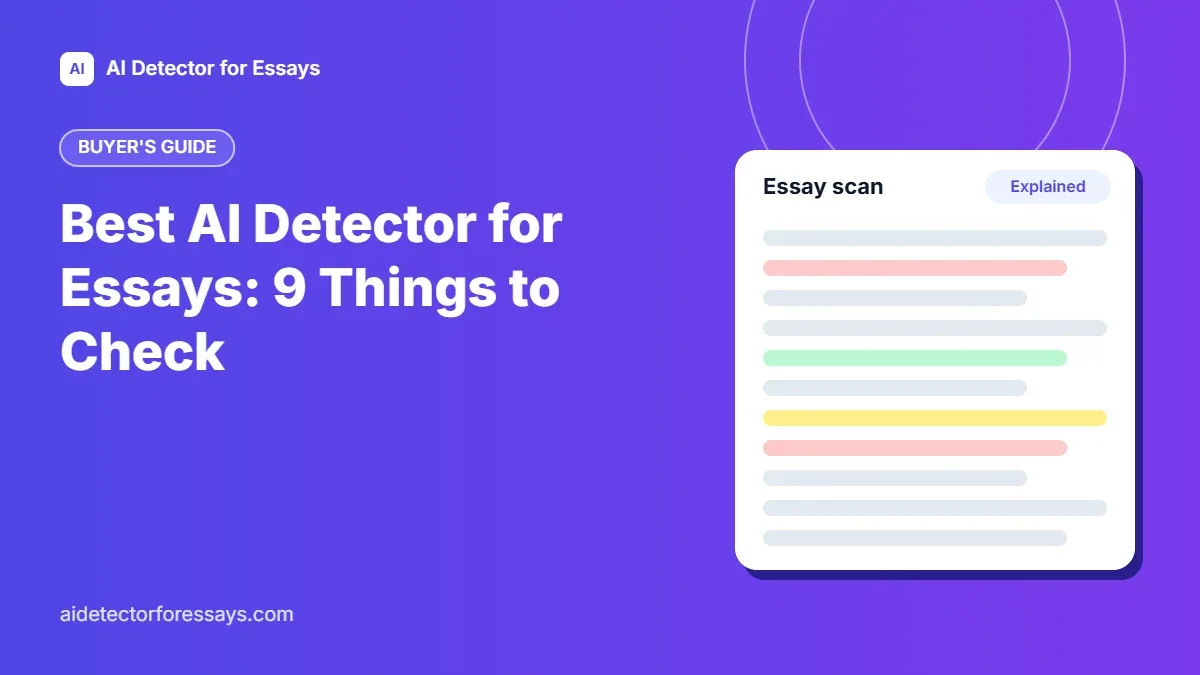
Sentence-Level Highlights, Not Just a Score
A single number like "62% AI" tells you almost nothing. Is the whole essay borderline? Or are three paragraphs clearly AI and the rest human? You can't tell.
The best AI detector breaks your essay down sentence by sentence and color-codes what looks suspicious. That turns a scary number into a short list of lines you can actually inspect.
Actionable tip: When you test a detector, paste in an essay you wrote yourself. If it flags everything or nothing, and gives you no detail, move on.
Clear Explanations for Every Flag
Highlights are good. Explanations are better. When a sentence gets flagged, you deserve to know why. Common reasons include:
- Very predictable word choices that a language model would likely pick.
- Uniform sentence length with little natural variation.
- Generic transitions like "Furthermore" and "In conclusion" stacked closely together.
- Vague, summary-style claims with no personal detail or specific evidence.
An AI detector for essays that explains its flags teaches you something. You learn to spot bland writing, add concrete examples, and strengthen your own voice. That's useful even when no AI was involved.
Built for Academic Writing, Not Marketing Copy
Here's a gap most "top 10 detector" lists ignore: training focus. A general AI content detector may have learned mostly from product descriptions and blog posts. Academic essays look different, with thesis statements, topic sentences, citations, and formal tone.
When a tool isn't tuned for essays, formal student writing can look "too clean," which pushes scores up unfairly. Look for a checker that says clearly it was made for essays, application statements, and coursework.
Signs a tool understands essays
- It mentions essays, coursework, or college applications specifically.
- It handles long documents without cutting off your conclusion.
- It pairs detection with writing tools like grammar or readability checks.
Honest About Accuracy and False Positives
No ai detector is perfect. Anyone who promises 100% accuracy is selling something. Even OpenAI retired its own AI text classifier in 2023 because of its low accuracy.
Research also shows detectors can be unfair. A Stanford-led study found that several popular detectors misclassified essays by non-native English writers as AI-generated far more often than essays by native speakers.
The best AI detector for essays doesn't hide from this. It tells you that results are probabilities, not proof, and it explains what a false positive looks like. Our own accuracy disclaimer covers this in detail, and every tool you use should offer something similar.
Enough Word Capacity for Real Essays
A 500-word limit sounds fine until you try to check a 2,500-word research paper. Splitting an essay into chunks breaks context and can change results.
Check these limits before you commit:
- Words per check: Can it handle your longest assignment in one go?
- Checks per day: Enough to test a draft, revise, and check again?
- File upload: Can you drop in a Word or PDF file instead of pasting?
For example, on AI Detector for Essays, guests can check up to 1,000 words three times a day, free accounts get 1,500 words five times a day, and paid plans on our pricing page cover essays up to 15,000 words with file uploads.
Privacy: What Happens to Your Essay?
This is the question almost nobody asks, and it matters. Your essay is your intellectual work. Some tools store submissions, reuse them for training, or share them in ways that aren't obvious.
Before pasting anything, read the privacy policy and look for answers to three questions:
- Is my text stored, and for how long?
- Is it used to train models?
- Can I delete my scan history?
If a tool can't answer these in plain English, that's your answer. You can review how we handle your text on our privacy policy page.
A Way to Prove You Wrote It Yourself
Detection only tells half the story. The other half is proof of process. If a teacher questions your work, a score from another detector won't settle it. Evidence of how you wrote it will.
That's where a writing-process recorder helps. Tools like our Writing Verifier record your typing, pauses, pastes, and revisions in a replay you can share with your teacher. It's the difference between saying "I wrote this" and showing it.
When proof of process matters most
- High-stakes essays like college applications or final papers.
- Classes where the teacher has said they'll use AI detection.
- Any time you've been flagged before and want peace of mind.
Features for Teachers and Bulk Checks
A teacher grading 120 essays doesn't have time to paste each one into a box. If you're an educator, look for an AI content detector that supports bulk uploads, keeps a scan history, and produces reports you can save.
Equally important, the tool should help you talk to students fairly. Sentence highlights and plain-language explanations make it easier to open a conversation instead of issuing an accusation. Our ChatGPT checker for teachers was designed around that idea.
Free to Try, Fair to Upgrade
You shouldn't have to hand over a credit card to find out whether a detector is any good. The best AI detector lets you test it free, ideally without creating an account.
Watch out for these pricing red flags:
- Hidden results that only unlock after payment.
- Auto-renewing trials that are hard to cancel.
- Vague word limits that only appear once you've pasted your essay.
If you just want a quick check today, try our free AI detector with no sign-up.
Essay-Focused AI Detector vs. Generic AI Content Detector
If you're still unsure why the type of tool matters, this quick comparison makes the difference clear.
| Feature | Essay-focused AI detector | Generic AI content detector |
|---|---|---|
| Output | Sentence highlights with reasons | One overall percentage |
| Writing style it expects | Thesis, evidence, citations, formal tone | Blogs, ads, product copy |
| Long documents | Full essays and research papers | Often short limits |
| Proof of authorship | Writing-process replay | Rarely offered |
| Teacher features | Bulk checks, history, reports | Usually single checks |
Neither type is "bad." A generic AI content detector can be fine for a marketing team reviewing freelance blog posts. But when the stakes involve grades, academic integrity, or a college application, you want a tool that understands how essays are actually written.
A quick story about choosing the wrong tool
Picture Daniel, a high school junior who writes carefully and edits every paragraph twice. His English teacher ran his persuasive essay through a free generic checker and got a high AI score. The tool offered no highlights and no explanation.
Daniel then checked the same essay with an essay-focused detector. It flagged only two sentences, both generic transitions in his introduction, and explained why. He rewrote them with a personal example, shared his drafts, and the concern disappeared in one short conversation.
Same essay. Different tool. Completely different outcome. That's why the features in this guide matter more than any brand name.
How to Test Any AI Detector in 10 Minutes
Don't trust marketing claims. Run your own quick experiment. It takes about ten minutes and tells you more than any review.
Step one: Use your own writing
Paste an essay you wrote completely by yourself. A good detector should rate it mostly human and explain any flags.
Step two: Try a clearly AI-written sample
Ask a chatbot to write a short essay on the same topic. The detector should catch most of it.
Step three: Mix the two
Combine a few of your paragraphs with a few AI paragraphs. The tool should highlight the AI sections, not just average everything into a middle score.
Step four: Read the explanations
Do the reasons make sense? Could you use them to improve your writing? If not, the tool isn't helping you.
Putting It All Together
Think of an AI detector for essays like a smoke alarm. A good alarm tells you which room the smoke is in. A bad one just screams. You want the tool that points you to specific sentences, explains itself, respects your privacy, and gives you a way to prove your work.
One more practical habit: save your results. Whether you screenshot a report or keep a scan history in your account, a record of your checks and revisions helps if questions come up weeks later. Combined with your drafts and notes, it builds a clear picture of how your essay came together, which matters far more than any single score.
Once you know these nine features, you'll spot a weak checker in seconds. And you'll stop letting a single red number decide how you feel about an essay you worked hard on.
Conclusion
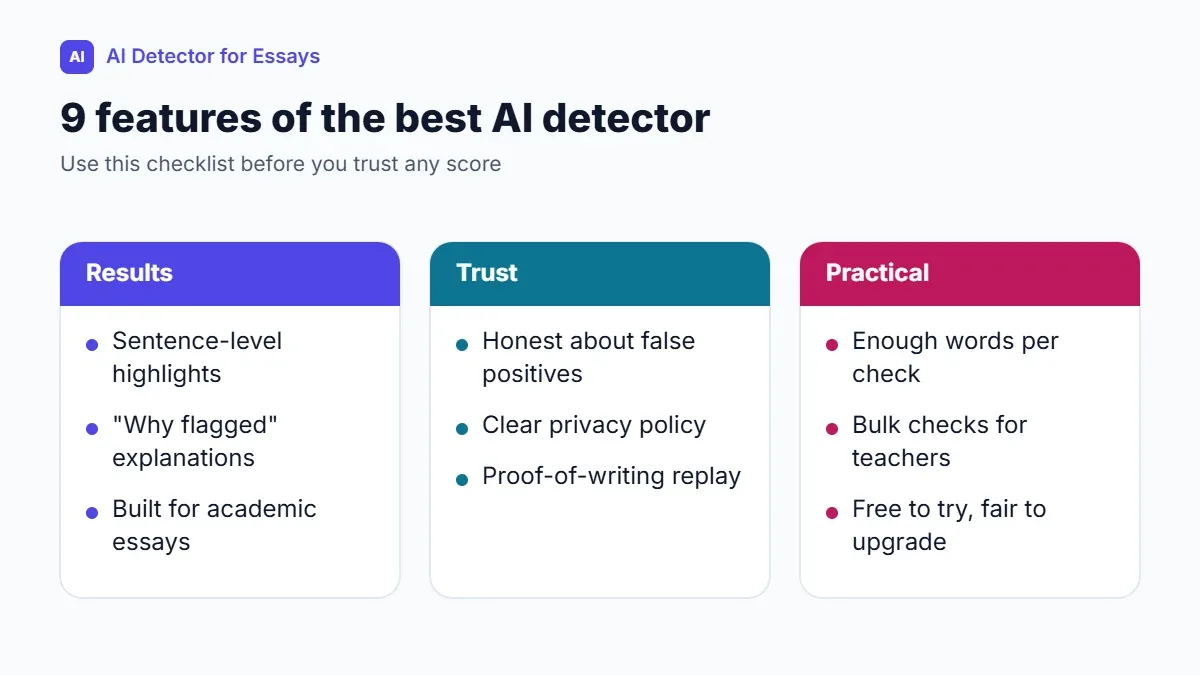
The best AI detector for essays combines sentence-level highlights, clear explanations, academic focus, honest accuracy claims, enough word capacity, strong privacy, and a way to prove authorship. Anything less leaves you guessing.
Ready to see how your essay reads? Check it free with AI Detector for Essays, review the highlighted sentences, and submit with confidence.