AI Detector for Essays: How to Check AI-Written Content and Improve Originality
An AI Detector for Essays helps students, teachers, researchers, and writers examine text for patterns commonly associated with artificial intelligence. By analyzing language patterns, sentence structures, and word predictability, an AI content detector can provide useful clues about how a piece of writing may have been produced. However, no detector can guarantee a perfectly accurate result, so its findings should always be reviewed carefully.
What Is an AI Detector for Essays?
An AI Detector for Essays is an online tool designed to estimate whether a written passage resembles text generated by artificial intelligence systems such as Chat GPT or other large language models. These tools examine statistical and linguistic patterns to identify characteristics that may be associated with machine-generated writing.
Students may use an AI detector to review an essay before submitting it. Teachers can use one as an additional resource when evaluating academic work, while content editors may check articles to better understand the writing process behind a draft.
It is important to understand that an AI detector does not directly observe who wrote a document. Instead, it analyzes the text and estimates the likelihood that certain sections resemble AI-generated content.
Who Can Benefit From an AI Content Detector?
- Students: Review essays and understand whether their writing contains repetitive or predictable language.
- Teachers: Identify passages that may deserve a closer look during academic reviews.
- Researchers: Examine writing patterns while maintaining transparent research practices.
- Bloggers: Review drafts for repetitive phrasing and improve readability.
- Editors: Add another quality-control step to a content review workflow.
- Businesses: Evaluate submitted documents when writing policies and disclosure requirements make such checks appropriate.
The purpose should be responsible evaluation rather than treating an automated score as unquestionable proof of authorship.
How Does an AI Detector Work?
Most AI detection systems analyze features of written language and compare them with patterns learned from examples of human-written and AI-generated text. Different providers use different models, datasets, and scoring methods, so two tools may evaluate the same essay differently.
Language Predictability
AI language models generate text by predicting likely sequences of words. Some detectors examine how predictable the words and phrases in a passage appear to be. Highly predictable language may sometimes resemble machine-generated writing, although human writers can also produce predictable sentences.
For example, a basic sentence such as “Water is essential for human life” is easy to predict. That does not mean a human could not have written it. Context matters, and simple sentences alone cannot establish authorship.
Sentence Variation and Structure
Another factor may involve variation in sentence length, phrasing, and structure. Some AI-generated passages have a consistent rhythm, repeated transitions, or similarly structured paragraphs. However, formal academic writing can naturally share these characteristics.
A well-edited essay written by a student may therefore appear more uniform than an informal personal blog post. Detection systems need to account for such differences, but they do not always do so reliably.
Probability Scores and Highlighted Passages
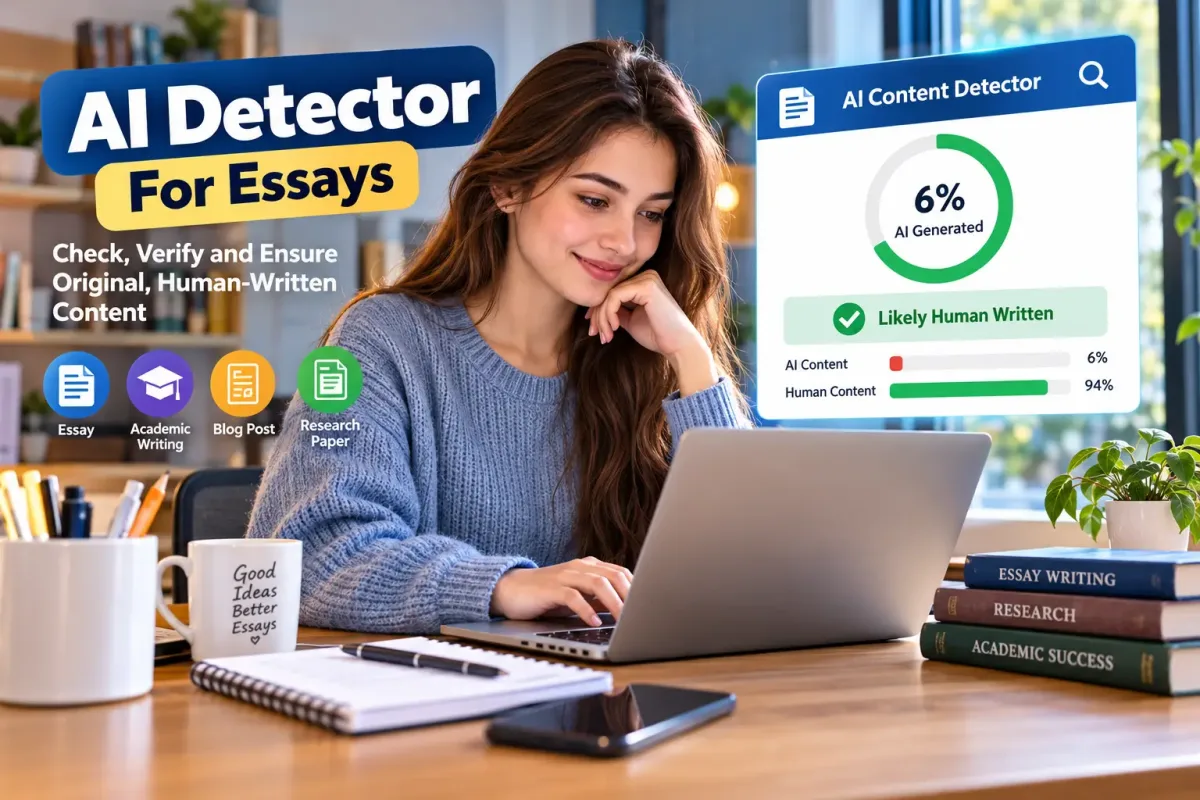
Many AI content detector tools display a percentage or highlight individual passages. The meaning of the percentage depends on the provider. It may represent a model's estimate of AI-like content rather than the actual percentage of words written by AI.
Before interpreting a result, read the tool's explanation of its scoring system. A score of 40%, for example, should not automatically be interpreted as proof that 40% of an essay was generated by AI.
How to Choose the Best AI Detector for Essays
The best AI detector is not necessarily the one that produces the lowest score or makes the strongest claims. A useful tool should explain its limitations, offer understandable results, protect submitted text, and perform reasonably well on the types of documents you need to evaluate.
Accuracy and Independent Evaluation
Look for information about how the detector was tested. Useful evidence includes performance on different writing styles, academic subjects, document lengths, and text produced by different AI models.
Be cautious when a provider advertises perfect accuracy without publishing meaningful evidence. Detection performance can change as writing tools evolve, and results from one test set may not reflect performance on every essay.
Support for Academic Writing
Choose an AI detector that is appropriate for essays, research assignments, reports, and other formal documents. A tool optimized for short marketing copy may not perform equally well on a lengthy academic paper.
Check whether it supports the language you write in, whether it accepts long passages, and whether it provides useful sentence-level explanations.
Privacy and Data Security
An essay may contain unpublished research, personal experiences, student information, or confidential material. Before uploading it, review the service's privacy policy and terms.
- Check whether submitted text is stored.
- Look for information about data retention and deletion.
- Determine whether submissions may be used to improve the service.
- Avoid uploading confidential or personally identifiable information unnecessarily.
- Follow your school's or employer's data-handling requirements.
Free Features and Paid Plans
A free AI detector may be sufficient for checking a short passage. Paid tools may provide larger word limits, detailed reports, batch processing, or integrations. Compare the actual features before paying for a subscription.
Do not assume that a paid detector is automatically more accurate. Price, convenience, privacy, and independently demonstrated performance are separate considerations.
How to Use an AI Detector for Essays Step by Step
Checking an essay is straightforward, but the way you interpret the report is just as important as the scan itself.
Prepare Your Essay
Save a complete copy of your draft before using a detection tool. If your essay contains quotations, references, headings, or template text, understand how those elements might affect the analysis.
Whenever possible, use a tool that explains its supported document length and language requirements.
Paste or Upload Your Text
Open the AI detector and enter your essay into the text box or upload a supported file. Some tools analyze text directly, while others accept documents in formats such as DOCX or PDF.
Do not submit confidential academic or professional material until you have checked the provider's privacy practices.
Run the Detection Check
Start the analysis and wait for the tool to generate its report. Depending on the service, you may receive an overall score, highlighted passages, or a breakdown of text classified as likely AI-generated or likely human-written.
Interpret the Results Carefully
Read the report as an estimate, not a verdict. Consider the type of essay, the length of the passage, and whether the tool explains its confidence or limitations.
If the result appears surprising, compare it with the original draft, your notes, your sources, and your revision history. You may also seek a second opinion from another reputable tool, but agreement between detectors still does not prove authorship.
Improve the Writing Where Necessary
Use the report as an opportunity to review clarity, originality, and reasoning. Rewrite confusing passages in your own words, support claims with appropriate evidence, and add analysis that reflects your actual understanding of the topic.
The objective is to create a stronger essay, not to manipulate a detector's score.
Can an AI Detector Identify ChatGPT-Written Essays?
Many detectors attempt to identify patterns associated with text produced by ChatGPT and other generative AI systems. Their ability to do so varies with the model, writing style, passage length, and degree of editing.
Some passages may be identified correctly, while others may be missed. A text produced by an AI model and subsequently edited by a human can be especially difficult to classify consistently.
Why AI-Generated Text Can Be Difficult to Detect
Modern language models can produce varied writing styles, and human writers often revise their work extensively. These overlapping characteristics make reliable classification challenging.
Other factors also complicate detection:
- Short text samples: A few sentences provide less evidence than a substantial passage.
- Common academic language: Formal phrases and standard explanations may appear in both human and AI writing.
- Editing and collaboration: A document may contain contributions from several people and tools.
- Language differences: Performance may vary across languages and writing proficiency levels.
- New AI models: Detector performance may change as generation systems improve.
For these reasons, an AI detector should support a broader review process rather than replace human judgment.
Why AI Detectors Sometimes Produce False Positives
A false positive occurs when a detector labels human-written text as AI-generated or unusually AI-like. This is a significant concern in education because an incorrect classification can create unnecessary stress or unfair suspicion.
Imagine a student who writes a carefully structured essay using formal vocabulary, consistent grammar, and a conventional five-paragraph format. The student may have developed these habits through years of practice. Yet a detector could still flag some of the writing because it resembles patterns in its training data.
Common Causes of False Positives
- Highly predictable or formulaic language.
- Short, repetitive, or heavily edited passages.
- Standard academic phrasing and familiar transitions.
- Writing by people who use simple sentence structures or have limited language proficiency.
- Differences between the detector's training data and the submitted essay.
A false negative is the opposite situation: AI-generated text is classified as human-written or is not flagged. Both errors show why detection results should be treated cautiously.
What Should You Do If Your Original Essay Is Flagged?
If you wrote the essay yourself and a detector reports a high AI likelihood, do not panic. Keep the evidence that demonstrates your writing process.
- Save outlines, research notes, and early drafts.
- Keep version history when working in a document editor that supports it.
- Retain source links and records of your research.
- Be prepared to explain your argument, evidence, and writing decisions.
- Ask the instructor or reviewer how the result will be evaluated.
A detector score by itself should not be treated as definitive proof of misconduct. Institutions may have their own procedures, and those policies should guide the next steps.
AI Detector vs. Plagiarism Checker: What Is the Difference?
An AI detector and a plagiarism checker address different questions. Although some platforms offer both features, the two technologies should not be confused.
What an AI Detector Checks
An AI detector estimates whether text contains patterns associated with machine-generated writing. It generally does not establish whether a passage has been copied from a particular source.
What a Plagiarism Checker Checks
A plagiarism checker typically compares submitted text against available sources, such as web pages, publications, or document databases. Depending on the service, it may identify matching phrases and provide links to possible sources.
Matching text is not always plagiarism. Properly cited quotations, common phrases, and references may also produce matches. Human review is needed to determine whether the use of a source is appropriate.
Which Tool Should You Use?
Choose the tool based on your concern:
- Use an AI detector when you want to examine possible AI-generated writing patterns.
- Use a plagiarism checker when you want to find potential text matches with existing sources.
- Use both when your assignment or editorial process requires separate checks for originality and AI use.
Neither tool replaces accurate citations, independent thinking, or a careful final review.
How to Make Your Essays More Original and Authentic
The strongest essay is built on a clear argument, relevant evidence, and the writer's own analysis. Instead of focusing only on how a detector might score your work, develop a process that makes your reasoning and contributions clear.
Start With Your Own Argument
Before drafting, write down the main point you want to communicate. Consider what you believe, what evidence supports your position, and what a reader needs to understand.
For example, if you are writing about the benefits of renewable energy, do more than list common advantages. Compare evidence, examine trade-offs, and explain why certain findings matter to your argument.
Use Reliable Sources and Explain Their Relevance
Research strengthens an essay when sources support meaningful analysis rather than simply filling space. Look for academic publications, government data, and reputable organizations relevant to your topic.
After presenting evidence, explain how it supports your claim. This connection between evidence and reasoning is an important part of effective academic writing.
Include Specific Examples
General statements can make an essay feel vague. Specific examples, carefully interpreted data, and relevant case studies help readers understand what you mean.
When appropriate, explain why an example is important, where it applies, and what its limitations might be.
Revise for Clarity and Flow
Read your essay aloud or review it paragraph by paragraph. Remove unnecessary repetition, replace vague statements with precise explanations, and check whether each section contributes to the main argument.
Vary sentence structure naturally when it improves readability, but do not make sentences awkward simply to change their appearance. Clear writing matters more than an artificial variation in style.
Disclose AI Assistance When Required
If you use an AI writing assistant for brainstorming, outlining, grammar suggestions, or other permitted tasks, follow your institution's or publisher's rules. Some assignments allow limited assistance, while others restrict or prohibit particular uses.
When disclosure is required, describe the assistance accurately. Never present generated research, fabricated references, or unsupported claims as verified facts.
Are Free AI Detectors for Essays Reliable?
A free AI detector can be a convenient starting point, especially when you need to examine a short essay without purchasing a subscription. However, free access does not guarantee strong performance, comprehensive reports, or robust privacy protections.
Some free services limit the number of words you can check, while others restrict detailed results or require account registration. Read the terms before submitting your writing.
What to Check Before Using a Free Tool
- Does it support the length and language of your essay?
- Does it explain what its score represents?
- Does it identify limitations or potential false positives?
- Does it explain how submitted content is stored or used?
- Does it require payment for the features you actually need?
Test a tool with a range of text types where you have a reasonable basis for knowing how the writing was produced. Even then, a few personal tests cannot establish a detector's overall accuracy.
For high-stakes academic or professional decisions, use a transparent evaluation process rather than relying on a single free website.
Responsible Ways to Use AI Detection in Education
AI detection is most useful when it is part of a fair and transparent academic process. Schools and universities should communicate their AI-use policies clearly so students understand what is permitted before beginning an assignment.
Teachers can consider a combination of evidence, including drafts, research notes, citation quality, classroom discussions, and the student's ability to explain their work. These sources provide context that an automated score cannot supply on its own.
Use Detection as a Conversation Starter
When a passage raises questions, an instructor can ask the student to describe the research process or explain a key argument. Such a conversation may clarify how the work was produced without treating an automated classification as conclusive evidence.
Protect Student Privacy
Educational institutions should consider whether third-party services are appropriate for student documents, especially when those documents contain personal or sensitive information. Policies should address data retention, access, and the use of submitted content.
Students should also understand the applicable rules before uploading their work to an external detector.
Limitations of AI Content Detector Technology
AI detection continues to evolve, but it faces fundamental challenges. The distinction between human and machine-generated language is not always clear, particularly when people use editing tools or AI systems assist with only part of a document.
Detector results may also depend on language, topic, passage length, and the model used to generate the text. A tool that performs well on one type of content may not work equally well on another.
Another important limitation is interpretability. A percentage or highlighted passage may appear precise without explaining exactly why the system reached its conclusion. Users should understand what the report measures before making decisions based on it.
Research from independent institutions can help users understand these limitations. For example, the National Institute of Standards and Technology provides resources on evaluating AI systems, while academic research on AI-text detection examines issues such as robustness and reliability.
Useful starting points include:
- National Institute of Standards and Technology: Artificial Intelligence
- Stanford Institute for Human-Centered Artificial Intelligence
- Research papers on AI and machine learning
These resources provide broader research and evaluation context; they should not be interpreted as endorsements of any particular AI detector.
Conclusion: Use an AI Detector for Essays Wisely
An AI Detector for Essays can help students, educators, researchers, and writers examine text for patterns associated with AI-generated content. The right tool can offer a useful additional perspective, especially when its results are clearly explained and its limitations are acknowledged.
However, no single score should determine whether an essay is authentic or whether a student has violated an academic policy. False positives, false negatives, language differences, and evolving AI technology all limit what automated detection can establish.
For the best results, choose a detector that suits your needs, protect your privacy, verify your sources, and use the report as a starting point for thoughtful review. Focus on strong arguments, reliable evidence, clear explanations, and transparent use of writing tools.
Ready to review your essay? Use an AI content detector as one part of your writing-quality process, then check your facts, strengthen your analysis, and make sure your final work follows the rules that apply to your assignment.
```